





Enhanced Cataract Surgery uses a femtosecond laser to replace several manual steps of traditional cataract surgery with computer-guided precision. Northwest Eye surgeons use this technology — called Femtosecond Laser-Assisted Cataract Surgery (FLACS) — to tailor your surgery to your own eyes using the [LASER SYSTEM NAME] platform.
The laser customizes your incisions. It softens the cataract before removal. It can correct astigmatism in the same procedure. Patients at our Golden Valley, Maple Grove, Minnetonka, St. Anthony, and Wayzata locations choose FLACS when they want that level of precision.
What Is Femtosecond Laser-Assisted Cataract Surgery?
FLACS replaces the handheld blade and manual measurements of traditional cataract surgery with a computer-guided laser. The laser maps your eye in 3D before surgery. Then it creates incisions, breaks up the cataract, and opens the lens capsule with a precision a surgeon’s hand can’t match on its own.
Northwest Eye offers FLACS through our Enhanced Cataract Surgery package, priced at approx. $1,500 per eye. Most insurance plans and Medicare treat this as an upgrade beyond standard cataract surgery, so it’s typically an out-of-pocket cost. Our team verifies your coverage and walks you through pricing at your consultation.
What Technology Does Northwest Eye Use?
Northwest Eye performs FLACS using the [LASER SYSTEM NAME] femtosecond laser. This system builds a detailed 3D map of your eye before surgery, then executes incisions and lens fragmentation based on that map rather than a fully manual technique.
How FLACS Works
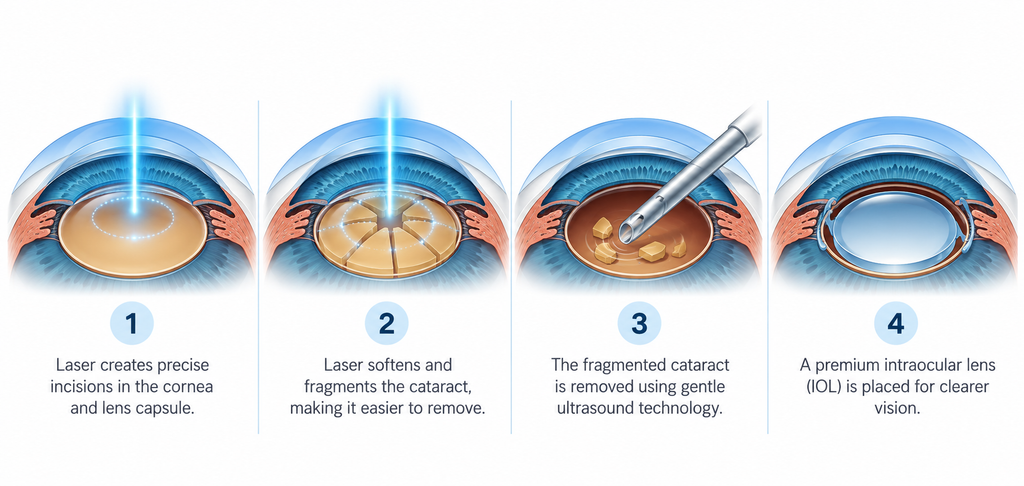
Each step is customized to your eye’s anatomy. Here’s what happens:
- Precise incisions: The laser creates consistent incisions in your cornea and lens capsule, based on detailed 3D imaging taken before surgery.
- Lens fragmentation: The laser softens and breaks up your cataract into smaller pieces. This reduces how much ultrasound energy your surgeon needs during removal.
- Gentle removal: Your surgeon removes the fragmented cataract with low-energy ultrasound, protecting the surrounding structures of your eye.
- Lens placement: Your surgeon places your new intraocular lens (IOL) into a precisely sized capsular opening. That improves its stability and position for clearer vision over time
Benefits of Choosing FLACS
- The laser creates incisions more consistent than a handheld blade — that consistency shows up in your surgical outcomes.
- Your surgeon programs the laser to your specific eye anatomy instead of relying on standardized cuts.
- Precise, computer-guided incisions lower your risk of complications like posterior capsule rupture or corneal damage.
- Your surgeon can use the laser to make precise arcuate incisions that correct pre-existing astigmatism — often reducing your need for glasses afterward.
- The minimally invasive approach reduces inflammation, which can speed up your visual recovery.
- Automation standardizes key steps of your procedure. That gives your surgeon more predictable outcomes, especially in complex cases.
Who Is a Candidate for FLACS?
Most cataract patients qualify for FLACS. Your surgeon confirms candidacy at your consultation based on your eye health, astigmatism, and vision goals. You’re a strong candidate if you:
- Want to reduce your dependence on glasses after surgery
- Have pre-existing astigmatism you’d like corrected during your cataract procedure
- Prefer the most customizable surgical option available
- Have a denser or more advanced cataract that could benefit from laser softening
At your consultation, your Northwest Eye doctor reviews your eyes, your lifestyle, and your goals, then recommends whether FLACS or traditional cataract surgery fits you best.
What Are the Risks of FLACS?
FLACS carries the same general risks as any cataract surgery: infection, inflammation, or a shift in vision correction. Its added precision can lower certain risks compared to fully manual techniques, but no cataract procedure eliminates risk entirely.
Your doctor reviews your personal risk factors, including existing eye conditions and overall eye health, before recommending FLACS.
FLACS vs. Traditional Cataract Surgery
| Feature | Traditional Cataract Surgery | FLACS (Enhanced Cataract Surgery) |
|---|---|---|
| Incisions | Made by hand with a blade | Created by a computer-guided laser |
| Cataract removal | Standard ultrasound energy | Laser softens the lens first, so less ultrasound energy is needed |
| Astigmatism correction | Needs a separate procedure | Corrected during the same surgery |
| Customization | Based on the surgeon’s manual technique | Programmed to your eye’s exact measurements |
| Cost | Typically covered by insurance/Medicare | Approx. $1,500 per eye, out-of-pocket |
Frequently Asked Questions
Schedule Your FLACS Consultation in Minnesota
Northwest Eye surgeons perform FLACS at our Golden Valley, Maple Grove, Minnetonka, St. Anthony, and Wayzata locations. Schedule a consultation to find out if FLACS fits your vision goals.






