


Credit Card Icon
Online bill pay
Calendar Icon
Book Now
Filed Paper Icon
patient portal
Doctor Icon
For Physicians
Phone Icon
(763) 416-7600

Femtosecond Laser Cataract Surgery (FLACS) in Minnesota

Enhanced Cataract Surgery uses a femtosecond laser to replace several manual steps of traditional cataract surgery with computer-guided precision. Northwest Eye surgeons use this technology — called Femtosecond Laser-Assisted Cataract Surgery (FLACS) — to tailor your surgery to your own eyes using the [LASER SYSTEM NAME] platform.

The laser customizes your incisions. It softens the cataract before removal. It can correct astigmatism in the same procedure. Patients at our Golden Valley, Maple Grove, Minnetonka, St. Anthony, and Wayzata locations choose FLACS when they want that level of precision.

What Is Femtosecond Laser-Assisted Cataract Surgery?

FLACS replaces the handheld blade and manual measurements of traditional cataract surgery with a computer-guided laser. The laser maps your eye in 3D before surgery. Then it creates incisions, breaks up the cataract, and opens the lens capsule with a precision a surgeon’s hand can’t match on its own.

Northwest Eye offers FLACS through our Enhanced Cataract Surgery package, priced at approx. $1,500 per eye. Most insurance plans and Medicare treat this as an upgrade beyond standard cataract surgery, so it’s typically an out-of-pocket cost. Our team verifies your coverage and walks you through pricing at your consultation.

What Technology Does Northwest Eye Use?

Northwest Eye performs FLACS using the [LASER SYSTEM NAME] femtosecond laser. This system builds a detailed 3D map of your eye before surgery, then executes incisions and lens fragmentation based on that map rather than a fully manual technique.

How FLACS Works

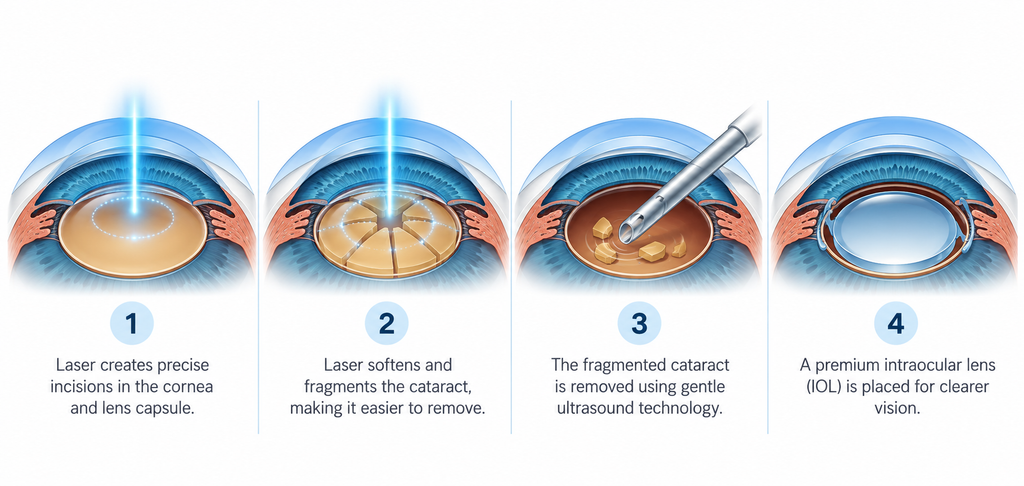
Each step is customized to your eye’s anatomy. Here’s what happens:

  1. Precise incisions: The laser creates consistent incisions in your cornea and lens capsule, based on detailed 3D imaging taken before surgery.
  2. Lens fragmentation: The laser softens and breaks up your cataract into smaller pieces. This reduces how much ultrasound energy your surgeon needs during removal.
  3. Gentle removal: Your surgeon removes the fragmented cataract with low-energy ultrasound, protecting the surrounding structures of your eye.
  4. Lens placement: Your surgeon places your new intraocular lens (IOL) into a precisely sized capsular opening. That improves its stability and position for clearer vision over time
Benefits of Choosing FLACS

  1. The laser creates incisions more consistent than a handheld blade — that consistency shows up in your surgical outcomes.
  2. Your surgeon programs the laser to your specific eye anatomy instead of relying on standardized cuts.
  3. Precise, computer-guided incisions lower your risk of complications like posterior capsule rupture or corneal damage.
  4. Your surgeon can use the laser to make precise arcuate incisions that correct pre-existing astigmatism — often reducing your need for glasses afterward.
  5. The minimally invasive approach reduces inflammation, which can speed up your visual recovery.
  6. Automation standardizes key steps of your procedure. That gives your surgeon more predictable outcomes, especially in complex cases.

Who Is a Candidate for FLACS?

Most cataract patients qualify for FLACS. Your surgeon confirms candidacy at your consultation based on your eye health, astigmatism, and vision goals. You’re a strong candidate if you:

  • Want to reduce your dependence on glasses after surgery
  • Have pre-existing astigmatism you’d like corrected during your cataract procedure
  • Prefer the most customizable surgical option available
  • Have a denser or more advanced cataract that could benefit from laser softening

At your consultation, your Northwest Eye doctor reviews your eyes, your lifestyle, and your goals, then recommends whether FLACS or traditional cataract surgery fits you best.

What Are the Risks of FLACS?

FLACS carries the same general risks as any cataract surgery: infection, inflammation, or a shift in vision correction. Its added precision can lower certain risks compared to fully manual techniques, but no cataract procedure eliminates risk entirely.

Your doctor reviews your personal risk factors, including existing eye conditions and overall eye health, before recommending FLACS.

FLACS vs. Traditional Cataract Surgery

FeatureTraditional Cataract SurgeryFLACS (Enhanced Cataract Surgery)
IncisionsMade by hand with a bladeCreated by a computer-guided laser
Cataract removalStandard ultrasound energyLaser softens the lens first, so less ultrasound energy is needed
Astigmatism correctionNeeds a separate procedureCorrected during the same surgery
CustomizationBased on the surgeon’s manual techniqueProgrammed to your eye’s exact measurements
CostTypically covered by insurance/MedicareApprox. $1,500 per eye, out-of-pocket

Frequently Asked Questions

FLACS stands for Femtosecond Laser-Assisted Cataract Surgery and refers to the use of a computer-guided femtosecond laser — rather than a handheld blade — to perform the most precise steps of cataract removal, including the corneal incisions, the opening in the lens capsule, and the initial breakdown of the cataract itself.

At Northwest Eye, FLACS is offered through our Enhanced Cataract Surgery package, which also includes the option to correct pre-existing astigmatism during the same procedure. Patients sometimes see this called “laser cataract surgery” or “bladeless cataract surgery” in other practices, but it refers to the same underlying technology.

In most cases, no. Medicare and private insurance plans classify standard cataract surgery as a covered medical procedure, but they treat the femtosecond laser portion of FLACS as a premium, elective upgrade — similar to how they handle premium intraocular lenses.

That means you typically pay the Approx.$1,500 per-eye cost directly, separate from whatever your plan covers for a standard cataract removal. Our team reviews your specific policy before your surgery date so you know your exact out-of-pocket cost in advance, with no surprise billing after the fact.

FLACS can reduce certain risks compared to fully manual cataract surgery. Because the laser creates incisions and opens the lens capsule based on precise 3D imaging rather than freehand technique, it lowers the chance of an irregular or off-center capsulotomy, which is one of the factors linked to posterior capsule complications.

The laser also pre-softens the cataract, which means your surgeon typically needs less ultrasound energy during removal, reducing stress on the surrounding corneal tissue.

That said, “safer” doesn’t mean risk-free; your individual risk still depends on factors like the density of your cataract, your corneal health, and any pre-existing eye conditions, which your doctor evaluates during your consultation.

Yes. During FLACS, your surgeon can program the laser to create limbal relaxing incisions (LRIs) — small, precise cuts at the edge of your cornea that reshape it slightly to correct pre-existing astigmatism.

Because the laser places these incisions with computer-guided accuracy, they tend to be more consistent than incisions made by hand. Correcting astigmatism this way, during your cataract surgery, means you avoid needing a separate procedure afterward, and many patients find they depend less on glasses for distance vision as a result.

Your doctor measures your corneal astigmatism during your pre-surgical evaluation to determine whether this step applies to you.

Most patients notice a visible improvement in their vision within the first one to two days after surgery, though your eye continues healing for several weeks afterward. Because FLACS uses less ultrasound energy than traditional surgery, many patients report less inflammation in the days immediately following the procedure, which can make early recovery more comfortable.

Full visual stabilization — meaning your eye reaches its final, stable prescription — generally takes a few weeks, which is also when your doctor can confirm your final glasses prescription, if you need one.

Northwest Eye prices Enhanced Cataract Surgery (FLACS) at Approx.$1,500 per eye, meaning a bilateral procedure if performed as two separate surgeries, which is standard practice.

This fee covers the femtosecond laser portion of your procedure specifically; the underlying cataract removal and standard intraocular lens may be covered separately by insurance or Medicare, depending on your plan.

Our team walks through your full cost breakdown, including any financing options, during your consultation — before you commit to scheduling.

Schedule Your FLACS Consultation in Minnesota

Northwest Eye surgeons perform FLACS at our  Golden Valley, Maple Grove, Minnetonka, St. Anthony, and Wayzata locations. Schedule a consultation to find out if FLACS fits your vision goals.

locations

Serving Our Community

With six locations throughout the Twin Cities metro area, Northwest Eye is among the largest eye care providers in the Midwest. Be Eye Wise and schedule a general eye exam or a specific service consultation today. We have optical  at the following offices:  Golden Valley, Minnetonka, Maple Grove, St. Anthony, and Wayzata, MN.

8501 Golden Valley Rd.,
Suite 100 & 200
Golden Valley, MN 55427
Additional Golden Valley Information
12501 Whitewater Drive, Suite 110
Minnetonka, MN 55343
Additional Minnetonka Clinic (Crosstown) Information
12000 Elm Creek Blvd N., Suite 100
Maple Grove, MN 55369
Additional Maple Grove Information
2601 39th Ave NE., Suite 1
St. Anthony, MN 55421
Additional St. Anthony Information
1903 E. Wayzata Blvd., Suite 110
Wayzata, MN 55391

Additional Wayzata Information
7125 Tamarack Rd, Suite 150,
Woodbury, MN 55125
Additional Woodbury Information
11091 Ulysses St NE., Suite 400
Blaine, MN 55434
Additional Blaine Surgery Center Information
9801 Dupont Ave S., Suite 100
Bloomington, MN 55431
Additional Bloomington Surgery Center Information
12501 Whitewater Drive
Suite 320
Minnetonka, MN 55343
Additional Crosstown Surgery Center Information
10709 Wayzata Blvd., Suites 100 & 120
Minnetonka, MN 55305
Additional Minnetonka Surgery Center Information




