





Posted by: Northwest Eye in glaucoma surgery recovery on October 30, 2026
Recovery depends on the procedure and the person
Glaucoma surgery recovery does not follow one universal schedule. Recovery varies by the glaucoma procedure and by your individual healing response, so a timeline that applies to one treatment may not describe what happens after another. The same procedure can also involve different recovery experiences from person to person.
Glaucoma procedures include laser treatments such as selective laser trabeculoplasty, argon laser trabeculoplasty, and laser iridotomy; minimally invasive procedures; trabeculectomy; and tube shunt placement. These approaches are not interchangeable when you are planning follow-up, activity, or questions about vision changes.
A useful recovery plan therefore starts with the exact procedure rather than a fixed number of days. Before surgery, identify the technique being considered, the early monitoring plan, the activities your treating professional will address, and the changes that should prompt contact. After surgery, use the instructions given for your eye and procedure as the controlling guidance.
The practical goal is not to predict your recovery from general information. The practical goal is to prepare for a conversation that makes your own recovery plan clear. Ask what was done, what follow-up is expected, what activity limits apply, and how your care team wants you to respond to unexpected changes.
Which recovery pathway applies to your procedure?
Your glaucoma procedure determines which recovery pathway you need to discuss. The main approaches described in the available guidance include:
- Laser treatment: SLT, ALT, and laser iridotomy are laser approaches, but the fact that a procedure uses a laser does not by itself establish the schedule or instructions for your eye.
- Minimally invasive glaucoma procedures: These procedures form a separate approach from laser treatment and from the more traditional operations listed below.
- Trabeculectomy: This operation can involve closer early monitoring because bleb management may include suture adjustments or minor in-office procedures.
- Tube shunt placement: This is another surgical approach with its own postoperative plan and follow-up needs.
Recovery can differ by approach. The procedure name should therefore be one of the first details you ask your treating eye-care professional to explain.
Ask, “Which exact glaucoma technique is planned for me, and what part of my recovery will depend on that technique?” You can then connect the answer to four practical topics: the first follow-up, the amount of rest, the changes in vision or comfort that need attention, and the longer-term monitoring plan.
That question also prevents a common misunderstanding: a general statement about a laser procedure should not be treated as a schedule for trabeculectomy, tube shunt placement, or another operation. Use the procedure-specific explanation from your own care team.
Questions to answer before glaucoma surgery
A comprehensive consultation is needed to create a personalized surgical plan. The questions below cover the planned technique, aftercare, follow-up, expected outcomes and risks, and available alternatives.
Bring these questions to the discussion:
- Which technique will be used, and why is it being considered for my glaucoma?
- What aftercare will I need immediately after the procedure?
- How many follow-up visits may be required, and when will the first visit occur?
- What outcomes should I expect to discuss, and which risks are relevant to this technique?
- Are alternatives to the proposed procedure available for my situation?
- Which changes in vision, redness, discomfort, or discharge should prompt me to contact the care team?
- Which activities will need a temporary adjustment, and how will I know when to resume them?
The first five questions come directly from the recommended preoperative discussion topics. The last two help connect that discussion to the recovery decisions you will need to make.
Write down the procedure name, the planned follow-up pattern, and the instructions for contacting the care team. If the plan changes, ask what changed and how that affects recovery. A personalized plan is more useful than trying to match your experience to a general timeline.
The first postoperative instructions are individualized
Your surgeon’s or doctor’s individualized postoperative instructions govern the first part of recovery. Follow those instructions rather than substituting a general schedule from another procedure or another person’s experience.
An eye shield, padding, or bandage may protect the operated eye. If your doctor places one of these coverings, keep it in place until your doctor tells you to remove it. The timing is therefore determined by the instruction you receive, not by a general rule about how long an eye covering should remain.
The same principle applies to the rest of your immediate care. Your treating professional decides which instructions apply to your eye, including the details of aftercare and any changes that require contact. General information can help you prepare questions, but it does not replace those directions.
Before leaving the procedure or postoperative visit, ask the care team to repeat any instruction you are unsure about. Make sure you understand what to do with an eye shield, padding, or bandage, which follow-up visit comes next, and how to reach the team if an unexpected change occurs. If an instruction seems different from general information you have read, use the individualized instruction for your eye and ask the care team to explain it.
Follow-up visits monitor healing and glaucoma care
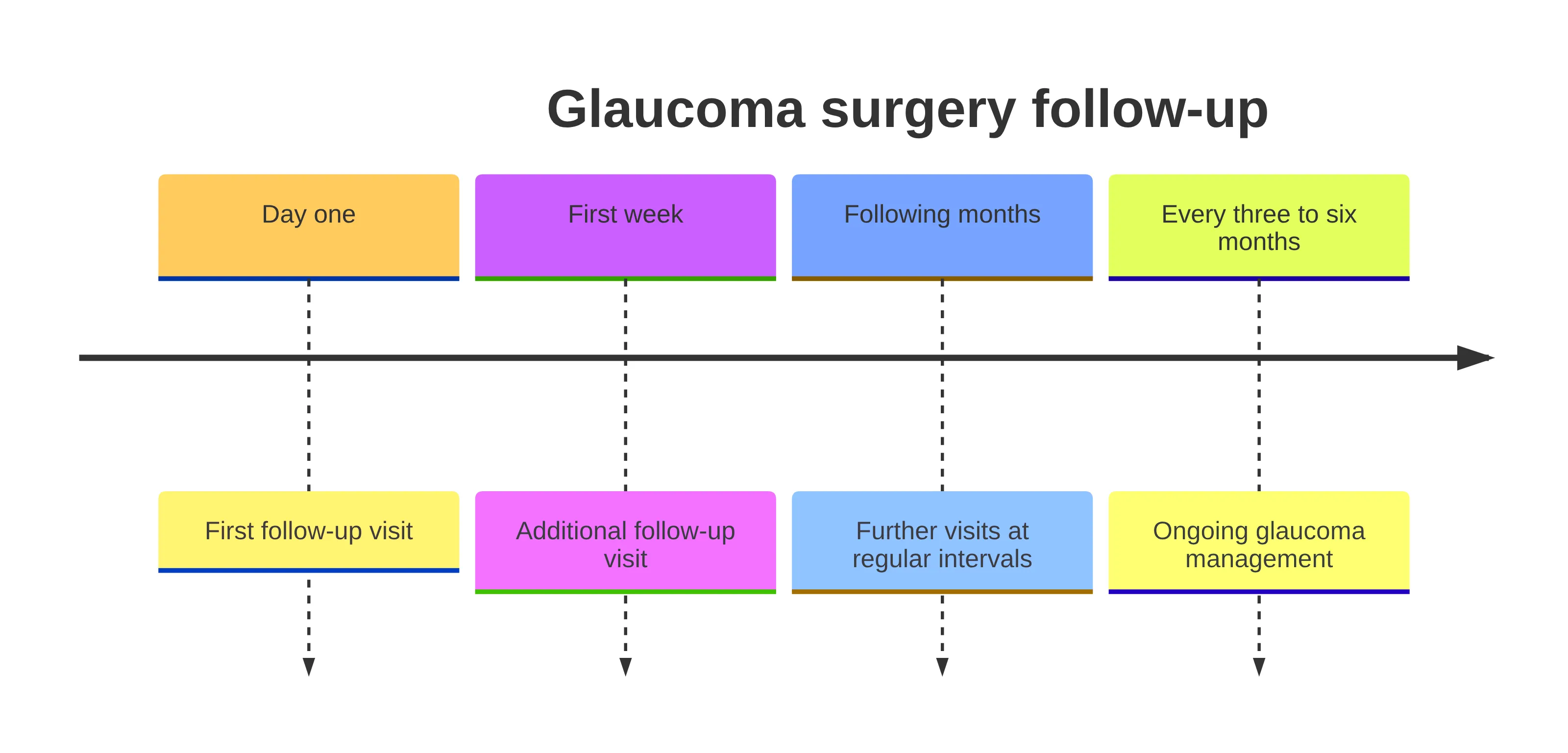
Several follow-up visits may be needed during the first few weeks after glaucoma surgery. The described pattern includes a visit on day one, another during the first week, and further visits at regular intervals over the following months. Regular follow-up helps the care team monitor healing and address complications that may arise.
The pattern is not identical for every procedure. After trabeculectomy, more frequent early follow-up may be needed because bleb management can involve suture adjustments or minor in-office procedures. That possibility is one reason the exact technique matters when you plan transportation, time away from work, and questions for the care team.
After the initial recovery period, appointments are usually spaced out to every three to six months for ongoing glaucoma management. The interval described for ongoing care does not replace the earlier visits that may be needed to monitor healing.
Use each visit to ask what the examination showed and whether the next visit will follow the same schedule. If your procedure was trabeculectomy, ask whether bleb management is part of the early follow-up plan. If your procedure was different, ask which features of that procedure determine the monitoring pattern.
A simple follow-up checklist can keep the discussion specific:
- What is the date or timing of my next visit?
- What will the care team assess at that visit?
- Which changes should I report before the scheduled visit?
- When will the early recovery visits give way to ongoing glaucoma-management visits?
- Could this procedure require an adjustment or another in-office step during early follow-up?
These questions help you understand the monitoring plan without assuming that every surgery follows the same sequence.
Use the visit sequence as an evolving plan rather than as a promise of a fixed recovery length. Early visits give the care team opportunities to monitor healing and address complications that may arise, while later appointments support ongoing glaucoma management. Ask what the team is assessing at each stage and what would cause the next visit to be scheduled sooner or later; the answer should come from your examination and procedure-specific plan, not from a general timeline. If trabeculectomy is involved, ask whether bleb management is expected to include suture adjustments or a minor in-office procedure. If an additional procedure is discussed, ask what it is intended to address and whether it changes the next follow-up. This turns the appointment schedule into a set of questions you can prepare for, while avoiding the assumption that another patient’s sequence will apply to you. If you are unsure, ask the team to explain the purpose of the next visit.
Activity and outdoor protection follow the care plan
Activity guidance depends on the procedure and on the instructions your surgeon or doctor gives you. Most office-based laser procedures typically require only one day of rest before returning to normal activities, according to the recovery guidance used for this topic. That timeframe should not be transferred automatically to trabeculectomy, tube shunt placement, or another glaucoma operation.
Ask your care team to address the activities that matter in your daily life. You may want to ask:
- How much rest should I plan for this specific procedure?
- When can I resume my usual work and household activities?
- Which activities should wait until the care team examines my eye?
- When can I return to exercise or other activities that require specific instructions?
- What should I do if an activity causes an unexpected change?
The direct answer for you comes from the postoperative plan for your eye, not from the shortest schedule described for a different procedure.
During recovery, sunglasses or protective eyewear outdoors can help shield your eyes from debris and ultraviolet rays. Ask whether your care team wants you to use protective eyewear and whether any additional instruction applies to your procedure.
Outdoor protection is one part of recovery planning. It does not answer how quickly you can resume every activity, so keep the broader activity questions with your individualized postoperative instructions.
Vision changes should be evaluated rather than assumed
Vision changes after trabeculectomy should be evaluated rather than automatically attributed to healing. The postoperative-care guidance states that cataract risk can increase after trabeculectomy and that any reduction in vision should be evaluated to determine its cause.
The same guidance describes a large drainage bleb as a possible contributor to poor tear-film spread, dryness, or discomfort after trabeculectomy. These details give you specific topics to raise if your care team has performed that procedure. They do not establish that every change has the same cause, and they do not predict what will happen in your eye.
If you notice reduced vision after trabeculectomy, contact the treating eye-care team so the change can be assessed. Describe when you noticed it, whether it is worsening, and whether it occurs with dryness or discomfort. Do not decide from a general recovery description that a reduction in vision can be ignored.
For a different glaucoma procedure, ask your own care team which vision changes require contact and how quickly they want to hear from you. The procedure-specific plan remains the boundary for interpreting what you notice.
When to contact the treating eye-care team
Redness accompanied by discharge or pus after trabeculectomy can signal infection and warrants immediate evaluation by an eye doctor. If you have had trabeculectomy and notice that combination, arrange immediate evaluation rather than waiting for a routine follow-up visit.
Avoid self-medicating—especially with steroid eye drops—if discharge or pus develops after eye surgery. Contact an eye doctor promptly so the finding can be assessed and the appropriate treatment decision can be made by a professional.
Before surgery, ask exactly how your treating team wants you to report concerning or unexpected changes. Keep that instruction with your postoperative information. Follow the individualized directions you receive, and contact the care team when a change falls within the situations they told you to report.
The immediate-evaluation instruction above is specific to redness with discharge or pus after trabeculectomy. Other symptoms may require a different response based on your procedure and examination, so do not apply that single example to every postoperative situation.
Recovery may require continued communication and adjustment
Some people may require additional procedures after glaucoma surgery, so continued communication with the healthcare team matters during recovery. The possibility of another procedure does not establish that one will be needed for you, and it does not provide a fixed prediction about your outcome.
If your care team raises an adjustment or additional procedure, ask what prompted the discussion, what the proposed step is intended to address, and how it would change your follow-up plan. Ask which symptoms or examination findings should lead you to contact the team before the next scheduled visit.
Useful questions after surgery include:
- What did today’s examination show about healing?
- Is the current follow-up schedule still appropriate?
- Does any change in vision, redness, dryness, or discomfort need attention before the next visit?
- Is an additional procedure being considered, or is continued observation the plan?
- Which instruction should I follow if my symptoms change outside office hours?
These questions keep the recovery discussion connected to your procedure and your current examination rather than to a generic timeline.
Prepare for a glaucoma recovery discussion in Minnetonka
A useful glaucoma recovery discussion in Minnetonka starts with the exact procedure and ends with a clear plan for follow-up and contact. Bring four questions to that discussion:
- Which glaucoma technique is planned, and how can recovery differ for that approach?
- What aftercare and activity instructions apply to my eye?
- When should I expect early follow-up, and how will ongoing glaucoma monitoring be scheduled?
- Which vision or symptom changes should prompt contact, and how quickly should I reach the care team?
Several follow-up visits may be needed during the first few weeks, and later appointments may be spaced out for ongoing glaucoma management. Follow your surgeon’s or doctor’s individualized postoperative instructions throughout that process. A qualified eye-care professional must decide what applies to your eye, procedure, and recovery; general education cannot make that decision for you.
Use the discussion to replace a fixed timeline with a procedure-specific plan. That approach gives you a clearer way to prepare, ask about changes, and respond when your recovery does not match your expectations.
Northwest Eye can be part of that care discussion for glaucoma concerns in Minnetonka. Bring your procedure questions and postoperative concerns so the conversation can focus on the information that applies to you.
Questions patients may ask about glaucoma surgery recovery
What should I expect during the recovery process after glaucoma surgery?
Recovery after glaucoma surgery varies based on the specific procedure performed and your individual healing response. It’s important to follow the personalized postoperative instructions provided by your surgeon.
How many follow-up visits will I need after glaucoma surgery?
Most patients can expect several follow-up visits in the first few weeks, including visits on day one and during the first week. After the initial recovery period, appointments are typically spaced out to every three to six months for ongoing glaucoma management.
What activities should I avoid during my recovery from glaucoma surgery?
Activity restrictions depend on the specific procedure you underwent. Most office-based laser procedures may require only one day of rest, while other surgeries like trabeculectomy may have different guidelines. Always consult your care team for personalized advice.
What questions should I ask my surgeon before glaucoma surgery?
Before surgery, consider asking about the specific technique that will be used, the expected outcomes, necessary aftercare, how many follow-up visits will be required, and any potential risks associated with the procedure.
What protective measures should I take during recovery?
Wearing sunglasses or protective eyewear outdoors can help shield your eyes from debris and UV rays during recovery. Always check with your care team for any additional protective measures specific to your procedure.






