




Posted by: Northwest Eye in Northwest Eye on October 28, 2026
Is Northwest Eye relevant to your cataract-care needs?
Your cataract-care question can be approached in two parts: whether you need an eye-care evaluation and whether a practice offers services that match the kind of guidance you want. We may be relevant if you want to discuss cataract-related concerns, because we offer cataract evaluations in Golden Valley, Maple Grove, St. Anthony, and Wayzata and describe advanced cataract surgery services.
The right next step depends on what you are experiencing and what a qualified eye-care professional finds. The American Academy of Ophthalmology says cataract surgery is often recommended when cataracts begin interfering with activities such as driving, reading, or seeing well at night. The same organization says that not everyone with cataracts needs immediate surgery; when symptoms are mild and do not interfere with daily activities, an updated eyeglass prescription may be enough.
This guide connects those general points with our documented services, locations, and appointment route. It does not assume that you need surgery, qualify for a particular lens, or have a specific recovery timeline.
Overview
At Northwest Eye, we are an eye-care practice based in Minnetonka, Minnesota, with cataract-related services that include evaluations and advanced cataract surgery information. Our published service information lists cataract evaluations in Golden Valley, Maple Grove, St. Anthony, and Wayzata. Those locations give you a starting point for considering access, but a location list does not determine which appointment, clinician, or treatment option fits your situation.
Cataract care usually begins with a conversation about your vision concerns and an evaluation rather than an automatic decision to have surgery. Your reason for contacting an eye-care practice may be simple: you want to understand whether changes in vision could relate to cataracts, whether a new prescription might help, or what options should be discussed if daily activities have become harder. An evaluation can help you move from a general concern to a more specific conversation.
You can use that route when your question is cataract-related or when you are not sure which service to select.
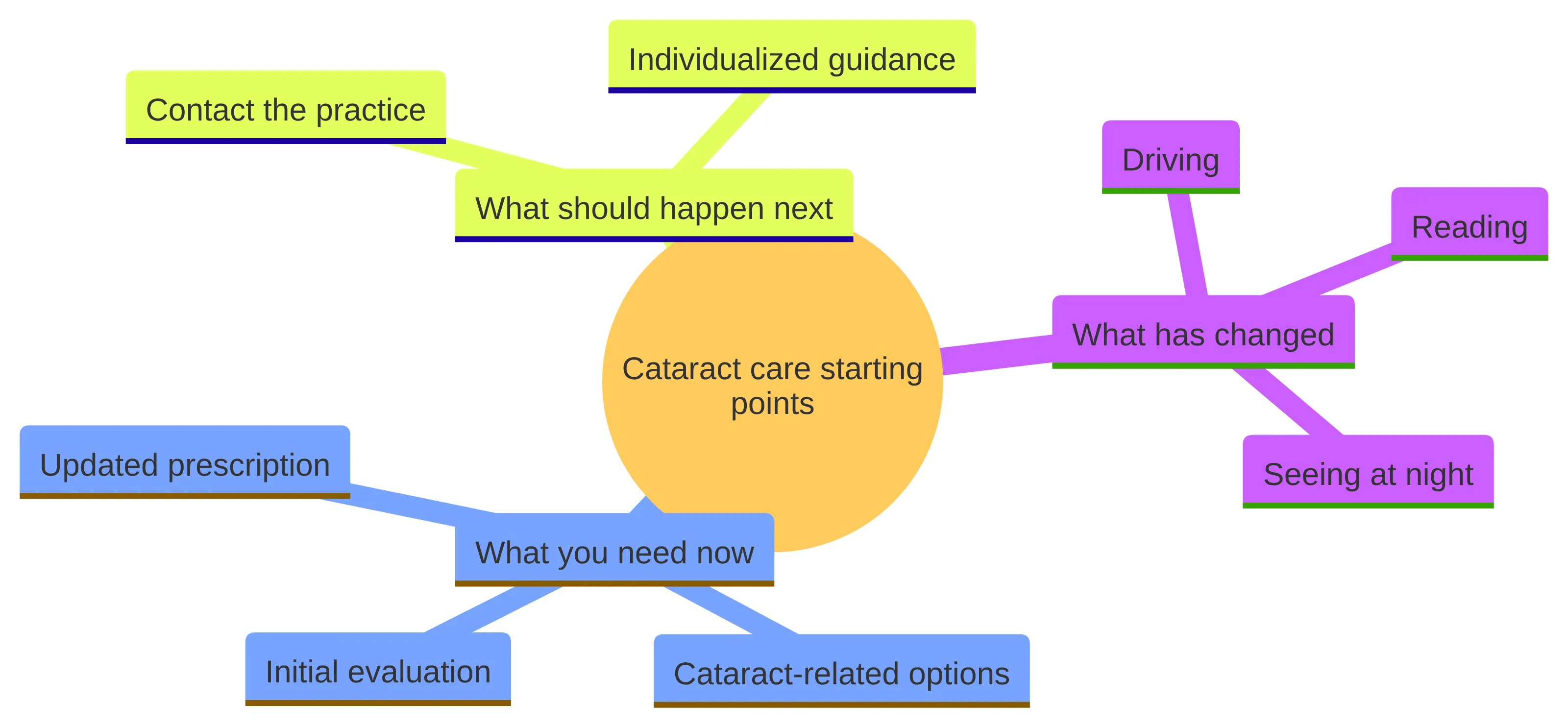
Your decision can be organized around three practical questions:
- What has changed? Note whether your concern affects driving, reading, seeing at night, or another daily activity. These details give the clinical conversation a clear starting point.
- What do you need now? You may want an initial evaluation, an explanation of cataract-related options, or help understanding whether an updated prescription should be considered.
- What should happen next? If you want individualized guidance, contact the practice through the appointment route rather than assuming that a service description answers a personal medical question.
The American Academy of Ophthalmology’s guidance supports keeping mild symptoms and activity interference separate. That distinction helps you ask for the kind of appointment or information you need without treating a general symptom description as a diagnosis.
What Northwest Eye offers for cataract-related concerns
Cataract evaluations and advanced cataract surgery are the two main service areas relevant to this question. We list cataract evaluations in four Minnesota locations: Golden Valley, Maple Grove, St. Anthony, and Wayzata. We also describe advanced cataract surgery using phacoemulsification and newer-generation intraocular lenses, commonly called IOLs.
An evaluation and a surgical service are related, but they are not the same decision. An evaluation gives you a setting to discuss your concerns and receive professional guidance. A description of surgical services tells you what the practice offers; it does not mean that surgery is the right next step for you.
You can use this distinction when deciding what to ask for. If you are still trying to understand what is happening with your vision, begin by describing your concerns and asking about an evaluation. If surgery has already been discussed elsewhere, bring the recommended lens type and your questions about follow-up to the conversation.
Patient education is another part of our described cataract approach. We emphasize patient education and the Light Adjustable Lens for people with cataracts. That statement identifies a topic we discuss; it does not establish that the lens is appropriate for every person or that it will produce a particular result.
You can make an education-focused visit more useful by bringing the questions that matter most to you. For example, you might want to understand the difference between lens choices, what follow-up involves, or whether you should first discuss an updated eyeglass prescription. Clear questions help keep the conversation focused on your circumstances rather than on a general description of technology.
The documented cataract services support a focused set of questions rather than a promise about outcomes. We use phacoemulsification and newer-generation intraocular lenses in our advanced cataract surgery services, but that fact does not tell you which procedure or lens type a clinician will recommend.
When you contact us, describe whether you are seeking an initial cataract evaluation, a discussion of surgery, or information about a lens option already raised with you. Naming your purpose can help direct the conversation without requiring you to decide your candidacy in advance.
Where cataract evaluations are offered
Cataract evaluations are offered in Golden Valley, Maple Grove, St. Anthony, and Wayzata. These are the locations identified in our published specialty information, so you can use them as the starting point when considering convenience and the location you want to ask about.
Your broader Twin Cities location may shape how you think about access. You may live in or travel from Minnetonka, Woodbury, Blaine, Bloomington, Maple Grove, Golden Valley, St. Anthony, or Wayzata, but you should not assume that every named community has the same cataract-evaluation availability. The documented list is limited to the four locations above.
For a cataract-related question, include your preferred location when you contact the practice.
Your preferred location is a practical detail to include when you contact the practice. You can state the location that is most convenient, describe whether you are seeking an evaluation or discussing a recommendation already made, and ask which appointment route applies.
A location list is not a confirmation of an appointment time or a statement about individual clinician availability. Treat it as a way to frame your request, then let the appointment team direct the scheduling conversation.
When a cataract evaluation may be worth considering
A cataract evaluation may be worth considering when changes in vision begin to interfere with activities that matter to you. The American Academy of Ophthalmology identifies driving, reading, and seeing well at night as examples of everyday activities that may be affected when cataracts interfere with vision.
That guidance does not mean that difficulty with one activity confirms a cataract or establishes that surgery is needed. It gives you a practical reason to describe the change to an eye-care professional. You can explain what you notice, when it affects you, and whether the issue is mild or disruptive in daily life.
Your reason for contacting an eye-care practice can be uncertainty as well as noticeable difficulty. If you want to understand whether your concerns relate to cataracts, whether an updated prescription should be considered, or what services may apply, describe that uncertainty when you reach out.
State that you are seeking cataract-related guidance so the request can be directed appropriately. Do not wait for a service description to answer a question that requires an examination or professional discussion.
What to ask when evaluating cataract care
Questions about the recommended lens type can help you evaluate cataract care. The American Academy of Ophthalmology advises asking about the ophthalmologist’s experience with the recommended lens type, including experience with premium lenses when that option is being considered.
You can ask:
- Which lens type is being discussed for me?
- What experience does the ophthalmologist have with that lens type?
- What factors make that lens appropriate or inappropriate for my situation?
- What additional cost should I understand if a premium lens is being considered?
These questions are not a request for you to select a lens on your own. They create space for the ophthalmologist to explain the recommendation and its conditions.
Follow-up arrangements deserve a direct question before surgery. The American Academy of Ophthalmology advises asking who will see you later on the day of surgery or the next day to check how you are healing; that person may be the surgeon, another ophthalmologist, or an optometrist.
Ask who provides that follow-up, when it occurs, and how you should communicate a concern after the procedure. The answer can help you understand the care pathway being discussed. It does not predict your recovery or guarantee that every patient follows the same schedule.
Questions about expectations can keep the conversation realistic. The American Academy of Ophthalmology says surgeons should not guarantee perfect vision and should explain that eyeglasses may still be needed under certain conditions.
You can ask:
- What vision changes should I realistically discuss for my circumstances?
- Under what conditions might I still need eyeglasses?
- If my symptoms are mild, should I discuss an updated prescription before considering surgery?
- What risks, benefits, and alternatives should be part of the decision?
The purpose of these questions is understanding, not obtaining a promise. A clear explanation should leave room for uncertainty and for the possibility that your next step is not surgery.
Practical questions can help you turn a general inquiry into a focused request. Tell the appointment team which of the documented cataract-evaluation locations you prefer, explain whether you want an initial evaluation or a discussion of an existing recommendation, and ask which appointment route applies.
You can also bring a short list of the activities affected by your vision, the questions you want answered, and any lens terminology you have already been given. This preparation does not replace clinical guidance, but it can help you use the appointment time for the issues that matter most to you.
How Northwest Eye describes its cataract approach
Our described cataract approach combines patient education with advanced cataract surgery services. We use phacoemulsification and newer-generation intraocular lenses in those services, and we emphasize the Light Adjustable Lens for people with cataracts.
For you, the practical meaning is that lens technology can be part of the discussion rather than a decision you need to make before an evaluation. You can ask what options are relevant to your circumstances, why a particular lens is being discussed, and what questions remain before you decide how to proceed.
Patient education also gives you permission to slow the conversation down. If a term is unfamiliar, ask for a plain-language explanation. If you are unsure whether your daily activities have changed enough to consider surgery, describe those activities and ask what should be considered next.
The Light Adjustable Lens is a service topic we emphasize, not a universal recommendation. The American Academy of Ophthalmology advises asking about experience with the recommended lens type and cautions that surgeons should not guarantee perfect vision.
A useful conversation therefore includes both options and limits. Ask what lens type is being discussed, why it may fit your circumstances, whether eyeglasses may still be needed under certain conditions, and who will provide follow-up later that day or the next day. Those questions help you evaluate the explanation without treating technology as a promised result.
What the available information does not establish
A cataract service description does not establish that you need surgery, qualify for a particular lens, or have a specific treatment timeline.
Your personal suitability must be discussed in a clinical setting. You can use the service information to decide what you want to ask about, but you should not treat the presence of phacoemulsification, IOLs, or the Light Adjustable Lens in a service description as a recommendation for you.
A cataract service description does not promise perfect vision or eliminate the possibility that you may still need eyeglasses.
That boundary matters when you compare what you hope to achieve with what can be discussed responsibly before an evaluation. Ask for the conditions that affect expectations, the lens type under consideration, and the follow-up plan rather than relying on a broad outcome statement.
A location list and an appointment request are not the same as a confirmed appointment. For other services, you can request a callback or call us at (763) 416-7600.
You can make that contact more useful by naming your preferred location and explaining that your question concerns cataract care. The appointment team can then direct the request without you assuming that a particular date, clinician, or service is already available.
How to request cataract-care guidance
Your next step is to describe your cataract-related concern and ask for guidance through the appropriate appointment route. Include the daily activities affected, the location you prefer among Golden Valley, Maple Grove, St. Anthony, and Wayzata, and whether you want an initial evaluation or a discussion of a recommendation already made.
A qualified eye-care professional must decide your individual suitability, timing, and treatment options after considering your circumstances. Use the conversation to ask clear questions, understand the limits of any recommendation, and decide what you want to do next.
What should you ask before requesting a cataract evaluation?
What services does Northwest Eye offer for cataract patients?
Northwest Eye provides cataract evaluations and advanced cataract surgery services, including the use of phacoemulsification and newer-generation intraocular lenses. Evaluations are available at locations in Golden Valley, Maple Grove, St. Anthony, and Wayzata.
When should I consider contacting Northwest Eye for a cataract evaluation?
You may want to contact Northwest Eye for a cataract evaluation if you notice changes in your vision that interfere with daily activities such as driving, reading, or seeing well at night. If symptoms are mild and do not disrupt your daily life, an updated eyeglass prescription may be sufficient.
How can I request an appointment at Northwest Eye?
To request an appointment at Northwest Eye, you can call (763) 416-7600 or visit their website to request a callback or schedule an appointment online. Be sure to specify your cataract-related concerns.
What should I ask during my cataract evaluation appointment?
During your cataract evaluation, consider asking about the recommended lens type, the ophthalmologist’s experience with that lens, follow-up care arrangements, and realistic expectations regarding vision outcomes after surgery.
What locations does Northwest Eye serve for cataract evaluations?
Cataract evaluations at Northwest Eye are offered in Golden Valley, Maple Grove, St. Anthony, and Wayzata. You can choose the location that is most convenient for you when requesting an appointment.