




Posted by: Northwest Eye in what is the success rate for laser surgery for glaucoma on October 29, 2026
What a glaucoma laser success rate can—and cannot—tell you
A glaucoma laser success rate is a study-specific measure, not a promise that every person will reach the same pressure, stop medication, or preserve vision in the same way. One study of selective laser trabeculoplasty, or SLT, found that 38.5% of treated eyes met that study’s success criteria at six months. The figure described the study’s chosen endpoint; it was not a universal rate for every glaucoma laser procedure or every patient.
The most useful question is not simply, “What percentage is successful?” Ask what the percentage measures, who was included, how long the eyes were followed, and what happened after the initial treatment. Those details determine whether a published result helps you think about your own situation or only provides a narrow research example.
The numerical example below concerns adults with open-angle glaucoma who received SLT. SLT is not a cure for glaucoma, and follow-up testing remains part of care. Whether you are considering information in Minnetonka, Golden Valley, Maple Grove, St. Anthony, Wayzata, Woodbury, Blaine, or Bloomington, use the number as a starting point for a focused conversation rather than as a forecast.
Glaucoma laser treatment can be discussed in terms of pressure control, medication use, or disease monitoring, but those outcomes are not interchangeable. A pressure reduction may meet a study endpoint without meaning that medication is no longer needed. Likewise, meeting a pressure-based definition does not by itself establish preservation of the visual field. Keep those distinctions in view before comparing percentages from different sources.
Start with the definition behind the percentage
An SLT success definition tells you exactly what the study counted as a favorable result. In the retrospective study used here, success meant at least a 20% reduction in intraocular pressure, or IOP, or a reduction of at least one glaucoma medication without another IOP-lowering procedure.
That definition combines two different pathways. One eye could qualify because its pressure fell by the required percentage. Another could qualify because medication use fell by at least one drug. The study therefore did not require every successful eye to reach the same pressure or have the same medication plan.
The phrase “success rate” can hide this composite structure. A percentage based on “20% IOP reduction or one fewer medication” is not the same as a percentage based on reaching a particular target pressure, avoiding further treatment, or maintaining a visual field. Before accepting a number as relevant, identify whether the study used an “or” definition, an “and” definition, or a separate result for each outcome.
A pressure-based endpoint measures pressure change. A medication endpoint measures treatment burden. Neither endpoint, by itself, measures preservation of vision. The study’s success definition did not say that qualifying eyes had preserved visual fields, and the Glaucoma Research Foundation explains that SLT is not a cure for glaucoma.
Use the definition to separate four questions:
- Did IOP fall by the amount the study required?
- Did the treatment plan allow a reduction in glaucoma medication?
- Is the pressure controlled well enough for the individual treatment target?
- What monitoring will assess the condition over time, including visual function when clinically appropriate?
Those questions may have different answers for the same person. A percentage answers only the question built into its endpoint.
The study denominator also matters. The research reviewed 252 eyes from 198 adults, so its percentages were reported for eyes, not as a simple percentage of individual people. One person could contribute more than one treated eye, and the eye-level result should not be restated as the percentage of patients who were cured or who no longer needed care.
The same study produced a six-month example—not a universal rate
The six-month example came from a retrospective study of 252 eyes from 198 adults with open-angle glaucoma who underwent SLT between July 2016 and February 2018. The study required at least six months of follow-up. These study details limit how broadly you can apply the percentages.
The study reported that 33.6% of eyes met its success criteria at two months. At six months, 38.5% of eyes met the same criteria. Both figures describe the composite definition: at least a 20% IOP reduction or at least one fewer glaucoma medication without another IOP-lowering procedure.
The increase from the two-month figure to the six-month figure does not mean that every eye improved continuously or that the six-month result predicts a later result. It only shows how many eyes met the selected definition at each reported time point in that study.
A six-month percentage can answer a narrow question: how many eyes in this particular SLT study met the study’s stated endpoint by six months? It cannot answer several broader questions without additional evidence. It cannot tell you that the same percentage will apply to another laser procedure, another glaucoma population, another baseline pressure, or another follow-up period.
The study involved adults with open-angle glaucoma. That population description should stay attached to the number whenever you use it.
When you encounter another success rate, compare the study details before comparing the numbers. Check these items:
- The laser procedure being studied.
- The type and stage of glaucoma included.
- Whether the unit is an eye or a person.
- The definition of success and whether it uses one endpoint or a composite.
- The follow-up period and whether additional treatment was excluded.
A higher percentage is not automatically a more useful result. A study may be measuring a different outcome or following a different population.
Why starting eye pressure can change the reported result
Starting IOP was associated with different SLT results in the study. Eyes with a baseline IOP above 18 mmHg had a greater likelihood of meeting the study’s success criteria at both two and six months. Among those eyes, the study reported a mean six-month IOP reduction of 5.4 ± 5.3 mmHg, or 23.7%.
Eyes with lower baseline IOP had a different six-month result. Their mean change was −0.7 ± 4.6 mmHg, described in the study as a 4.9% increase. In that group, the average change did not match the study’s desired pressure-reduction direction.
These findings show why a percentage without a starting pressure can mislead. A 20% reduction is calculated from the baseline value, and the same absolute pressure change represents a different percentage at different starting points. A starting pressure above 18 mmHg was associated with a greater likelihood of meeting this study’s endpoint, but that association is not a guarantee for any individual eye.
Your starting IOP gives the reported percentage a personal context, but it does not settle the treatment decision. Ask which pressure measurement the clinician is using as your baseline, whether that pressure has been consistent, and what pressure outcome matters for your glaucoma plan.
The study’s finding also does not mean that a lower starting pressure is undesirable. A lower measured pressure may simply make a percentage-based reduction harder to achieve, while the clinically relevant question may involve a different target or outcome. The study does not establish an individual target for you, so keep the numerical example separate from your own treatment plan.
The study assessed several baseline characteristics, including glaucoma type and severity, but its clearest reported association with meeting the success criteria was the starting IOP above 18 mmHg. Do not use the baseline-pressure finding to predict your result without considering the procedure, diagnosis, disease status, and follow-up plan together.
Pressure reduction is not the same as every treatment goal
Pressure reduction is one glaucoma treatment outcome, while medication use and visual function are separate concerns. The SLT study counted either a 20% IOP reduction or a reduction of at least one medication, so its success rate did not require both outcomes at once.
A study endpoint based on IOP tells you how pressure changed. A medication endpoint tells you whether the treatment plan used fewer pressure-lowering medicines. Neither endpoint alone tells you whether visual-field loss was preserved, whether existing vision improved, or whether glaucoma stopped requiring observation. Those questions require their own clinical assessment and follow-up.
Separate the goals before you interpret a result:
- Pressure reduction: The measured IOP falls by the amount specified in the study or discussed in the treatment plan.
- Treatment control: The pressure is managed within the target selected for the individual eye.
- Reduced medication needs: The person uses fewer glaucoma medications, if that is appropriate and sustained.
- Preservation of vision: Visual function remains stable over the monitoring period.
The available SLT percentage directly addresses the first item and partly incorporates the third through its composite definition. It does not establish the second or fourth item for you. A clinician can explain how pressure and visual-function findings are considered together.
A useful appointment question is: “When you describe success for my treatment, are you referring to a percentage pressure reduction, a target pressure, fewer medications, stable testing, or several of these together?” Another is: “Which outcome will you check first, and when will you reassess it?” These questions turn a broad success claim into measurable points that you can understand.
A successful laser response may still require medication
Medication use can remain part of glaucoma care after SLT. The Glaucoma Research Foundation explains that some patients are controlled with SLT alone, while others need glaucoma medication or additional IOP-lowering treatment. A study percentage that includes medication reduction therefore does not mean that everyone who meets the endpoint stops medication.
The Glaucoma Research Foundation describes SLT as equivalent to one glaucoma medication for treatment planning, while noting that some patients need SLT plus one or more medications. That comparison is a planning framework, not a promise that laser treatment will replace a particular drug or produce the same pressure response for every eye.
Medication questions belong next to the pressure questions. Ask your eye-care professional:
- If the treatment reaches the expected pressure outcome, would medication continue, change, or possibly decrease?
- What result would make additional IOP-lowering treatment part of the plan?
- How will you know whether a medication change remains appropriate over time?
The answers depend on the treatment goal and the follow-up findings. Do not stop, restart, or change glaucoma medication based on a published percentage.
A successful response and freedom from further care are different ideas. SLT is not a cure for glaucoma, and appropriate follow-up and testing remain important regardless of the treatment method used. Treat medication changes as part of a monitored care plan rather than as the automatic meaning of laser success.
Follow-up duration changes what success means
Follow-up duration changes the question that a success percentage can answer. The SLT study reported results at two months and six months, with a minimum follow-up of six months. The two-month figure showed how many eyes met the study definition at that early time point; the six-month figure showed how many met it by the later reported time point.
A six-month result should not be presented as a long-term result. The study’s minimum follow-up gives the six-month number a defined boundary, but it does not establish how the same eyes would be classified at a later interval. You need the follow-up period beside every percentage before deciding what it says about duration.
Ongoing monitoring has a separate purpose from the first post-treatment measurement. The Glaucoma Research Foundation states that appropriate follow-up and testing with an eye-care professional remain critical after glaucoma treatment, including SLT. That means an early pressure response does not remove the need to understand the later testing schedule.
Ask when pressure will be checked after treatment, which tests will be used to assess the treatment plan, and what finding would prompt a change in care. The published study supplies two time points, but your clinician must explain the monitoring schedule that applies to your eyes.
The phrase “works” can refer to an early pressure response, a medication change, continued control, or stability on later testing. Those are different time-based questions. When someone quotes a success rate, ask whether the figure describes the first response, the result at six months, or a longer period, and ask what happens if the first result does not meet the treatment goal.
When the evidence may be less reassuring
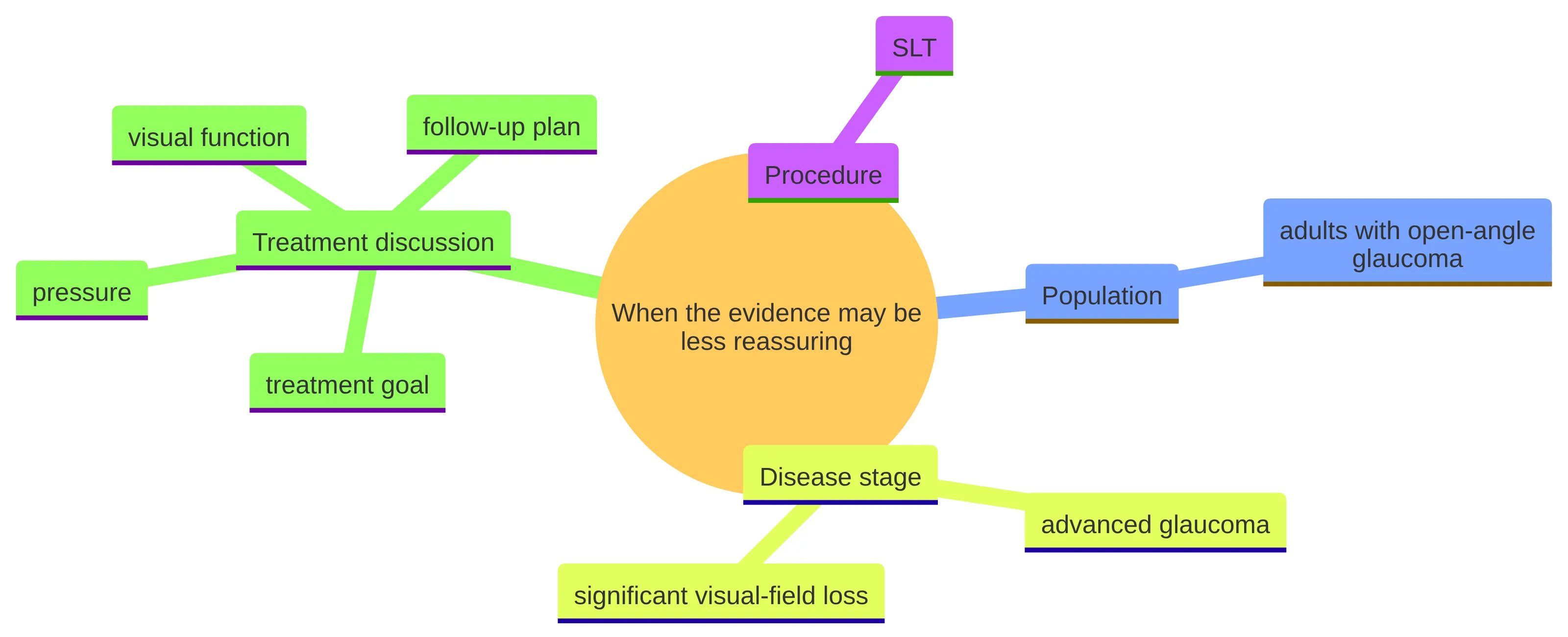
Advanced glaucoma with significant visual-field loss is a setting in which SLT’s limitations may become more apparent, according to a narrative review. This statement does not determine whether SLT is appropriate for your eyes, and it does not supply a single success percentage for advanced disease. It does show why disease stage and visual-field status belong in the discussion.
A pressure response may still be only one part of the plan when visual-field loss is significant. Ask how the treatment goal is defined for your stage of glaucoma, how pressure and visual function will be monitored, and what the plan would be if the response is not sufficient.
The available numerical result has a narrower scope than the phrase “laser treatment for glaucoma” suggests. The study involved SLT in adults with open-angle glaucoma, while the review specifically discusses limitations in advanced cases with significant visual-field loss. Those details do not support applying 38.5% to every laser procedure, every glaucoma type, or every stage.
Procedure, glaucoma type, disease severity, starting IOP, and follow-up duration all belong beside a reported percentage. The study identifies an association with starting IOP, and the review highlights a caution about advanced disease; neither source establishes a comparative success table for every combination of these factors.
If your situation differs from the study population, treat the number as background rather than as a personal estimate. Ask which parts of the study resemble your diagnosis and which do not. A useful answer should connect the proposed procedure and your treatment goal to a follow-up plan instead of relying on a percentage alone.
Questions to bring to a glaucoma appointment
A glaucoma appointment is the place to connect a published percentage with your procedure, pressure, disease stage, and monitoring plan. The following questions are designed to clarify what “success” would mean in your care rather than to produce a number that applies to every eye.
Bring these questions with you:
- Which laser procedure are you discussing? Ask whether the information applies to SLT or to a different procedure. The numerical example in this article is specific to SLT.
- What does success mean for my treatment plan? Ask whether the goal is a percentage IOP reduction, a target pressure, fewer medications, stable visual testing, or a combination.
- What is my baseline IOP, and what pressure outcome are you targeting? Starting IOP was associated with different results in the cited SLT study, so the starting measurement should not be left out of the discussion.
- How does my glaucoma type and stage affect the interpretation? The cited study involved adults with open-angle glaucoma, and a narrative review identifies greater limitations in advanced glaucoma with significant visual-field loss.
- When will you assess the response? Ask which result matters at the early check and which result matters at six months or another later interval.
- Could medication remain part of the plan? Some patients are controlled with SLT alone, while others need medication or additional IOP-lowering treatment.
- What testing will continue after treatment? Follow-up and testing remain important because SLT is not a cure for glaucoma.
- What would happen if the first response is not enough? Ask how the care plan would be reassessed rather than assuming that one percentage determines the next decision.
Write down the answer to each question in the terms used by your clinician: the procedure, the intended pressure outcome, the medication plan, and the follow-up interval. This creates a practical record of what the quoted percentage means in your situation. It does not replace the examination or the testing used to assess glaucoma.
Use the percentage as a starting point for care planning
A glaucoma laser success rate becomes useful only after you identify its procedure, population, endpoint, baseline pressure, and follow-up period. The cited SLT study reported that 38.5% of eyes met its composite success criteria at six months, but that result did not promise vision preservation, medication-free control, or freedom from further care. Starting IOP and disease stage can change how the number should be read, and ongoing testing remains part of glaucoma management.
Use the questions above to prepare for a focused discussion about realistic outcomes and the plan for monitoring them. Only a qualified eye-care professional can determine whether a treatment is appropriate for your eyes and explain how the available evidence applies to your individual situation.
If you are preparing for that discussion from Minnetonka or another Twin Cities community, bring the percentage together with the questions that give it meaning.