




Posted by: Northwest Eye in Glaucoma Care on October 28, 2026
When a child or family member may need glaucoma evaluation
Glaucoma evaluation can help clarify concerns that home observations and online information cannot settle. Glaucoma is associated with damage to the optic nerve and vision, while early disease may not produce specific, sensitive findings. A diagnosis typically requires assessment by an eye specialist and follow-up over time, so a single observation or measurement should not be treated as a diagnosis.
For a child, your observations can still provide useful information. Notice changes in overall vision, eye alignment, or the appearance of the eyes, and share those observations during an eye appointment. Pediatric eye-evaluation guidance also recommends asking about family history, including glaucoma, and arranging a comprehensive eye examination soon after a medical or genetic diagnosis that raises the risk of eye problems.
A practical first step is to arrange professional advice when:
- You have a family history of glaucoma or another serious eye concern.
- You have noticed a change in your child’s vision, eye alignment, or eye appearance.
- A clinician has identified a medical or genetic condition associated with higher eye-problem risk.
- You want to understand whether a family member needs an examination rather than relying on an online screening question.
These reasons do not establish that anyone has glaucoma. They identify topics to bring to an eye-care professional.
Why glaucoma care may continue beyond one visit
Glaucoma care may continue beyond one visit because diagnosis typically requires specialist assessment and follow-up over time. Early disease may lack specific and sensitive findings, so the clinician may need to compare examinations and other results rather than rely on one isolated finding. The cited glaucoma guidance also includes ongoing management recommendations and indicators of progression.
That approach can feel frustrating when you want a quick yes-or-no answer. The purpose of follow-up is to give the clinician a way to assess how the findings fit together over time and whether the management plan remains appropriate. It also gives you a chance to report changes, ask about treatment, and address practical problems such as using prescribed drops.
For families, continuity means keeping the care plan organized:
- Record the reason for the appointment and the observations that prompted it.
- Bring the family and medical history that may help the clinician assess risk.
- Ask what the examination showed and which findings require follow-up.
- Write down the treatment instructions, including how prescribed drops should be used.
- Keep the recommended follow-up appointment instead of treating an initial reassuring result as a permanent answer.
The last point is a boundary, not a prediction about your family member’s condition. Follow-up is part of the assessment pathway when the clinician believes more information is needed.
Risk discussion comes before conclusions
Glaucoma risk discussion begins with history and clinical findings, not with a conclusion drawn from one symptom or family story. The cited ICO guidance recommends assessing glaucoma risk factors and clinical signs during a comprehensive eye examination, and it recommends regular screening for first-degree relatives of people with glaucoma.
Family history is therefore worth bringing up clearly. Northwest Eye encourages families to share their health history because it can help identify risk factors for serious eye diseases. Tell the clinician which relative had glaucoma, if you know the relationship, and share any information you have about the diagnosis or prior eye care.
Risk information helps determine what deserves attention; it does not confirm disease. A family history can support a conversation about examination and follow-up, while the examination itself supplies the clinical information needed for a diagnosis. Do not use a family-history detail to decide that your child or another family member has glaucoma, and do not dismiss a concern simply because no relative has been diagnosed.
Before an appointment, gather:
- The family history of glaucoma and other significant eye conditions.
- Relevant medical or genetic diagnoses.
- The date and reason for any earlier eye examination, if known.
- Current eye drops or other prescribed treatments.
- Questions about what should happen next and when follow-up is needed.
What caregivers notice—and what it can and cannot mean
Caregiver observations about a child’s overall vision, eye alignment, and eye appearance can help inform an eye evaluation. Pediatric eye-evaluation guidance describes these observations as valuable information, but the observations do not by themselves diagnose glaucoma.
Describe what you noticed in concrete terms. You might record when the change became noticeable, whether it appears in one or both eyes, and whether it is present all the time or only in particular situations. Do not turn that record into a home test. Its purpose is to help you communicate accurately with the clinician.
A useful observation can lead to a useful question: “Could this finding require a comprehensive eye examination?” The answer depends on the clinical assessment. Online information can help you prepare what to report, but it cannot examine the eye, measure eye pressure, assess the optic nerve, or determine whether follow-up is needed.
If the concern involves a child with a medical or genetic condition associated with higher eye-problem risk, pediatric guidance recommends arranging a comprehensive ophthalmic examination soon after that diagnosis. Bring the relevant diagnosis and timing to the appointment so the clinician can consider it in context.
Screening is not the same as diagnostic evaluation
Glaucoma screening and diagnostic evaluation answer different questions. Screening looks for a reason to investigate further in a defined group or setting, while diagnostic evaluation addresses a person’s findings, history, and symptoms through clinical assessment.
The cited ICO guidance concluded that general-population mass screening had limited utility, while recommending assessment of risk factors and clinical signs during comprehensive eye examinations. It also recommends regular screening for first-degree relatives of people with glaucoma. This supports a risk-based conversation rather than treating a broad population test as a universal answer.
The U.S. Preventive Services Task Force gives a separate, narrower statement: for asymptomatic adults aged 40 or older, it found insufficient evidence to determine the balance of benefits and harms of screening for primary open-angle glaucoma. That statement applies to asymptomatic adults in that age group. It does not apply to people reporting signs or symptoms of vision loss or people already diagnosed with other glaucoma types, and it does not provide a screening schedule for children.
Use those distinctions when you decide what to do next:
- If you have a family history, ask an eye-care professional how it affects the need for evaluation or follow-up.
- If you have noticed a change in vision, eye alignment, or eye appearance, describe it and ask whether a comprehensive examination is appropriate.
- If a family member already has a glaucoma diagnosis, ask what regular monitoring that person needs.
- Do not use an adult screening statement to rule out the need for a child’s evaluation.
Screening language cannot diagnose your family member. A professional evaluation is the appropriate next step when there is a concern.
What a comprehensive glaucoma evaluation may involve
A comprehensive glaucoma evaluation may include several examinations and measurements rather than one standalone test. The cited glaucoma diagnosis guidance lists a dilated retinal examination, applanation tonometry, gonioscopy, slit-lamp examination, corneal-thickness measurement, and automated visual-field testing.
These terms describe different parts of an eye assessment. The clinician may examine the retina and the structures at the front of the eye, measure eye pressure, assess the angle of the eye, measure corneal thickness, and test parts of the visual field. The exact combination used for you or your family member depends on the clinical situation and the examiner’s judgment.
The word “may” matters. You should not assume that every person needs every listed test, and you should not assume that one normal-looking result answers every glaucoma question. Diagnosis typically requires an eye specialist to follow the person over time because early disease may not produce specific, sensitive findings.
Before the appointment, ask:
- Which parts of the evaluation are recommended for this concern?
- What will each examination or measurement help the clinician assess?
- Will the eyes need to be dilated, and what should you plan for afterward?
- Which result would lead to follow-up, and when should that follow-up occur?
- What information should you bring from prior eye examinations or medical care?
Those questions prepare you to understand the pathway without trying to interpret the results independently.
The listed components are complementary, not interchangeable. Applanation tonometry provides an eye-pressure measurement; gonioscopy assesses the angle; slit-lamp and dilated retinal examinations allow the clinician to examine eye structures; pachymetry measures corneal thickness; and automated visual-field testing assesses aspects of the person’s field of vision. These descriptions explain why a comprehensive evaluation uses more than one type of information, but they do not turn any individual result into a diagnosis.
A pressure result is therefore not a stand-alone answer to a glaucoma concern. The clinician must interpret it with the examination, history, and other results. This also explains why a home observation or online questionnaire cannot reproduce the assessment. If a family member has already had an examination, bring the prior information when possible and ask which results can be compared at a later visit.
You can make the results easier to understand by asking three specific questions: Which findings are reassuring, which findings remain uncertain, and what would lead to repeat testing or follow-up? Ask the clinician to explain unfamiliar terms in relation to the person being evaluated, rather than trying to match one result to a general online description.
How treatment choices fit into the care pathway
Glaucoma treatment choices are made after the clinician considers the examination and diagnosis. Common treatment categories described in the cited ophthalmology source include prescription eye drops, laser procedures, and surgery. These categories are not options for you to select from without an eye-care professional’s assessment.
The cited treatment source describes lowering intraocular pressure as the goal of treatment and identifies pressure as a primary risk factor for optic-nerve damage. That explains why pressure may be one part of the discussion, but it does not tell you which treatment is appropriate for a particular person.
If drops are prescribed, ask for practical instructions rather than relying on memory:
- What is the name and purpose of each drop?
- How much should you use and when?
- What should you do if a dose is missed?
- Which effects should you report?
- When will the clinician assess how the plan is working?
Laser procedures and surgery also require a clinician-led discussion of the proposed treatment, its purpose, and the follow-up plan. Avoid presenting one category as universally preferable. The available treatment categories support a conversation about choices; they do not establish a single treatment for every type of glaucoma or every age group.
Do not start, stop, or change prescribed treatment based on an online explanation. Ask the prescribing clinician for direction, especially when a child is involved or when the family is managing more than one medication.
Control, follow-up, and everyday questions families may have
Follow-up is part of managing glaucoma because diagnosis and assessment may require observation over time. The cited guidance says that people prescribed glaucoma drops should continue them and follow their clinician’s treatment advice. Keep the follow-up plan with the medication instructions rather than treating either as optional.
Everyday health habits can be discussed with the clinician, but they do not replace prescribed treatment. The cited glaucoma-care guidance identifies balanced eating, regular exercise, not smoking, and maintaining a healthy weight as general-health habits, while also stating that these habits do not replace conventional glaucoma treatment.
For a family member living with an ongoing glaucoma plan, make the routine practical:
- Keep a written list of prescribed drops and instructions.
- Use a calendar or another reminder that fits your household.
- Record questions or changes between appointments.
- Bring the medication list and your notes to follow-up visits.
- Ask what to do if the routine becomes difficult or a dose is missed.
You can also ask whether any everyday activity, medication, or health condition needs to be discussed in relation to the treatment plan. The answer should come from the clinician who understands the person’s diagnosis and prescribed care.
A healthy routine supports communication and adherence; it is not a substitute for examination, prescribed treatment, or follow-up. If you are unsure whether a change needs professional attention, contact an eye-care professional rather than trying to settle the question through self-care alone.
What available information cannot answer about cure or long-term outlook
Whether glaucoma can be cured and what long-term outlook to expect are individual clinical questions. A general explanation cannot determine those answers for your child or family member because diagnosis, treatment selection, and follow-up depend on the person’s clinical assessment.
The available care pathway supports a more useful expectation: do not assume that one appointment, a healthy habit, or a treatment category provides a universal cure. Glaucoma diagnosis typically requires specialist assessment and follow-up over time, while treatment is directed toward lowering intraocular pressure and managing the risk of optic-nerve damage. Those facts support ongoing clinical management, not a promise about a particular person’s future vision.
If you are asking whether a family member can live with glaucoma over time, focus the conversation on the plan rather than on a universal prediction. Ask what the diagnosis means, what the treatment is intended to do, how progress will be assessed, and which follow-up findings would change the plan. If drops are prescribed, continue them and follow the clinician’s instructions; general-health habits do not replace that care.
Do not use the absence of a clear symptom, a home observation, or an online result to declare that glaucoma has been ruled out. Arrange professional assessment when there is a concern, and ask the clinician to explain the diagnosis and outlook in terms that fit the person being evaluated.
Prepare for a useful glaucoma conversation
A glaucoma conversation becomes more useful when you bring the history, observations, and questions that help the clinician assess risk and plan evaluation. Family history, caregiver observations, and relevant medical or genetic diagnoses all belong in that discussion.
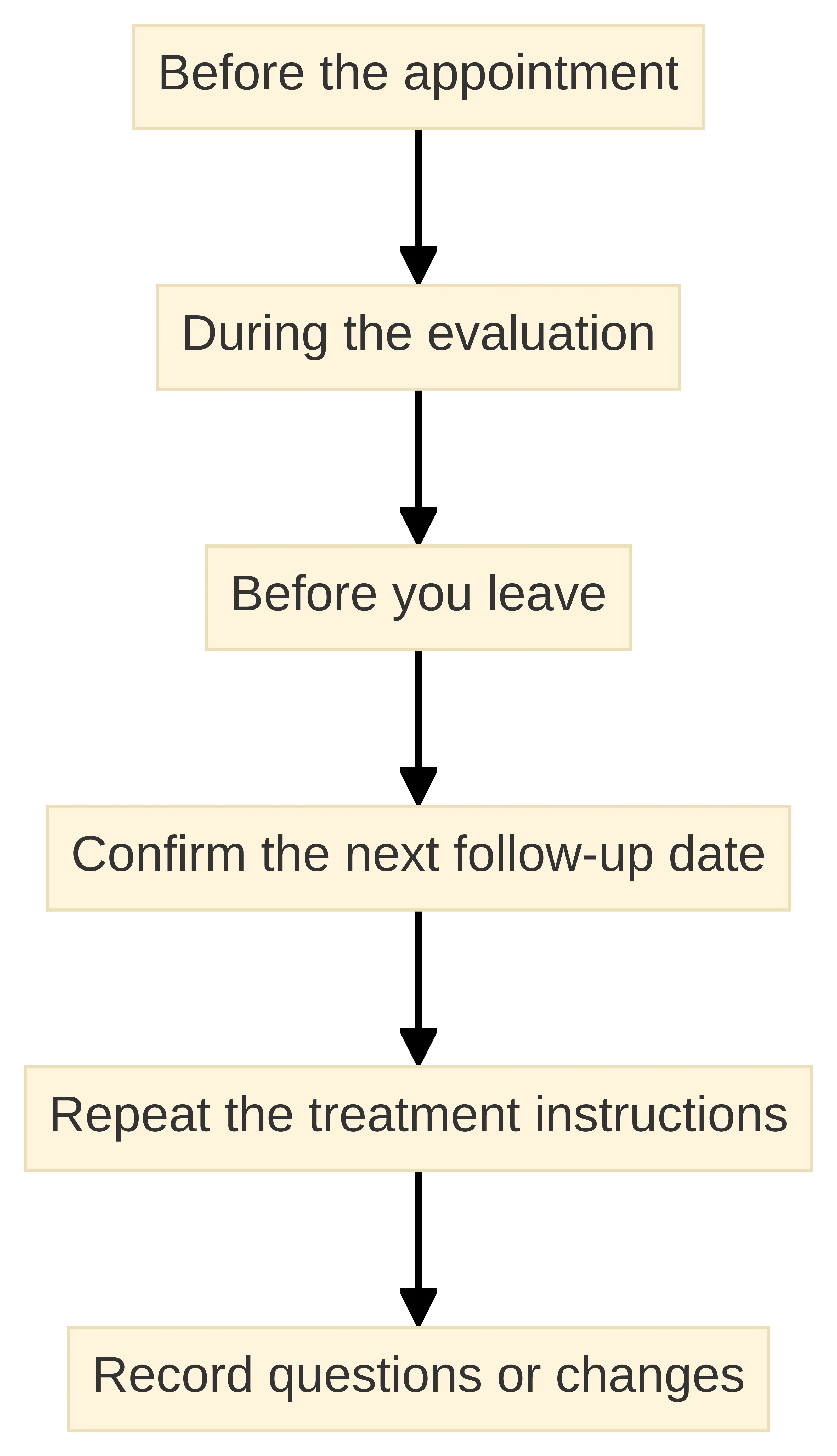
Use this preparation list:
Before the appointment
- Write down what you noticed, when you noticed it, and whether it changed.
- List family members with glaucoma or other significant eye conditions.
- Gather prior eye-examination information if it is available.
- List current medicines, including prescribed eye drops.
- Note relevant medical or genetic diagnoses.
During the evaluation
- Ask which examinations or measurements are recommended and why.
- Ask whether the findings support screening, diagnostic evaluation, or follow-up.
- Ask what the clinician can conclude now and what requires observation over time.
- Ask how to use any prescribed treatment and what to do if a dose is missed.
Before you leave
- Confirm the next follow-up date or the condition that should prompt contact.
- Repeat the treatment instructions in your own words.
- Ask which questions or changes you should record between visits.
- Ask whom to contact if the plan becomes difficult to follow.
This list organizes the conversation; it does not diagnose glaucoma or determine whether treatment is needed. If a clinician recommends a comprehensive examination, follow that recommendation rather than substituting an online questionnaire or home observation.
Arrange a local glaucoma discussion in Minnetonka
If you are in or near Minnetonka and want to discuss glaucoma concerns, family history, or the need for an evaluation, Northwest Eye’s Minnetonka clinic is a local place to start that conversation. Bring your observations, family history, medical information, and questions about examination and follow-up. A qualified eye-care professional can decide what evaluation and care are appropriate for the person being assessed.
Questions families may ask about glaucoma care
What is glaucoma and why is it important to seek care?
Glaucoma is a condition that can damage the optic nerve and lead to vision loss.
What should I do if I notice changes in my child's vision or eye appearance?
If you notice changes in your child’s vision, eye alignment, or appearance, it’s important to schedule an appointment with an eye-care professional for a comprehensive evaluation.
How can family history impact glaucoma risk assessment?
Family history is an important factor in assessing glaucoma risk. Sharing details about relatives with glaucoma can help the clinician determine the need for screening and further evaluation.
What lifestyle habits can support glaucoma management?
While lifestyle habits like a balanced diet, regular exercise, and avoiding smoking are beneficial for overall health, they do not replace prescribed glaucoma treatments. It’s important to continue following your clinician’s advice regarding medication and care.